
Custom Ceramic Dining Table Tops for OEM Furniture Manufacturing
Custom Sizes · Extendable table compatibility· Export-ready production
Built for dining furniture brands, wholesalers, and contract programs requiring stable flatness, repeatable dimensions, and scalable production quality.
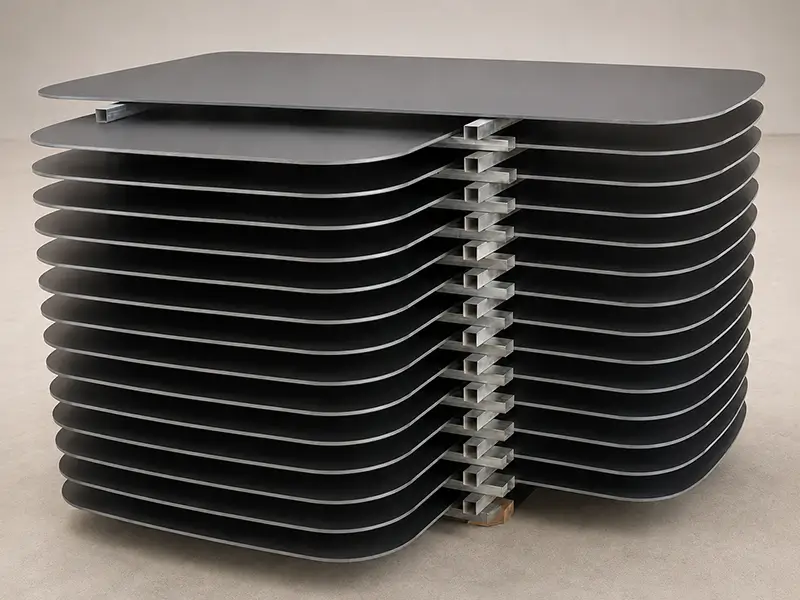
pain point
Common Challenges in Ceramic Dining Table Production
We engineer our production process to reduce the most common sourcing and manufacturing risks faced by furniture brands.
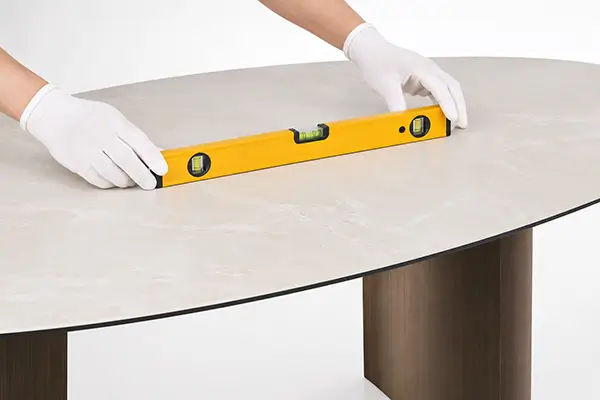
Large Format Flatness
Large-format ceramic dining tops require proper reinforcement and structural balance to minimize bowing, uneven surfaces, or instability over time.
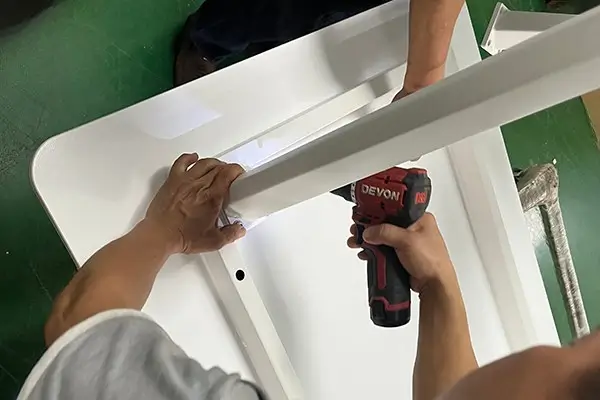
Frame Compatibility
Incorrect tolerances create installation problems between tabletop and metal/wood bases.
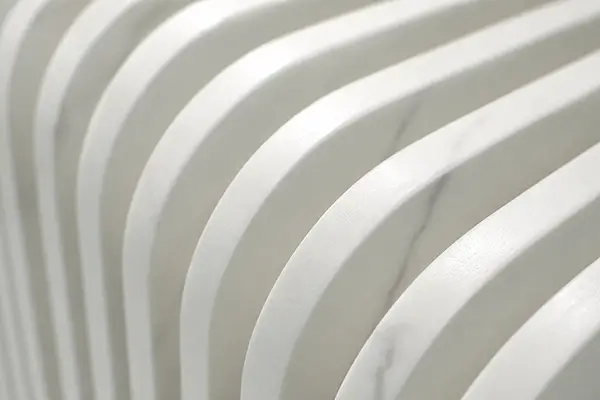
Batch Consistency
Surface matching and edge finishing must remain stable across repeated production runs.
PHYSICAL PERFORMANCE
Why Ceramic Works for Dining Table Applications
Choosing the right tabletop material directly affects product lifespan, customer satisfaction, and maintenance costs.
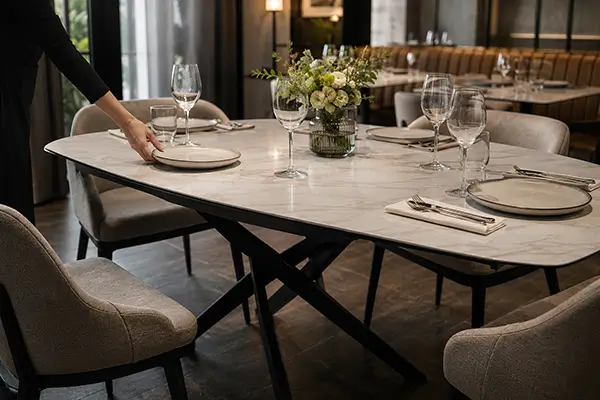
Engineered for high-frequency dining environments with superior scratch resistance and long-term surface durability.
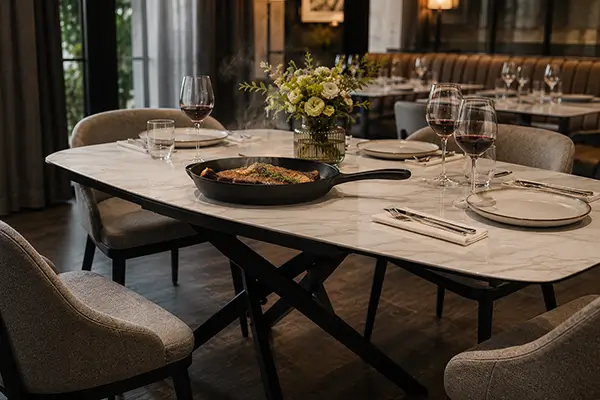
Unlike wood or resin-based materials, hot dishes, coffee pots, and warm cookware can be placed directly on the surface without causing deformation or finish damage.
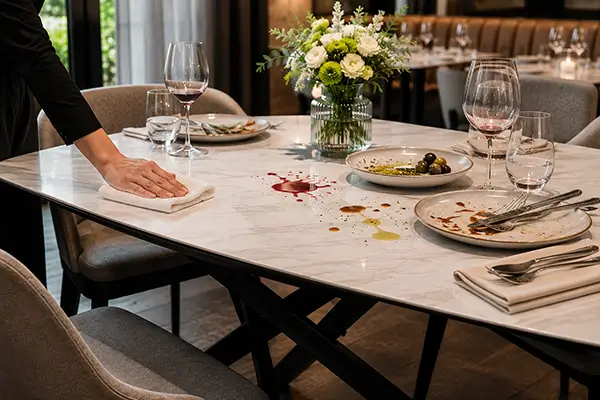
Non-porous ceramic surfaces resist wine, coffee, sauces, and oil absorption while helping reduce bacteria buildup. Easy wipe-clean maintenance supports both family dining and hospitality environments.
dining tabletop structure
Recommended Structures for Dining Table Applications
Different dining furniture collections often require different tabletop constructions depending on span, weight, and design direction.
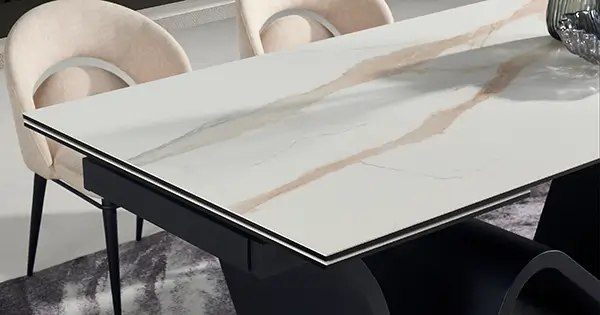
3mm ceramic + tempered glass reinforced structure
Best for:- Slim-profile dining tables
- Export programs
- Long-span stability
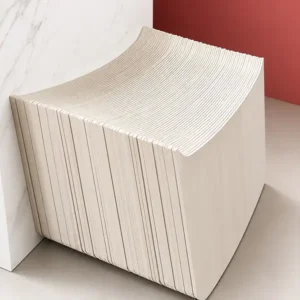
12mm+ full-body ceramic construction
Best for:
- Luxury dining collections
- Premium edge detailing
- Monolithic stone appearance
SHAPES & SIZING SYSTEMS
Dining Table Shapes & Size Compatibility
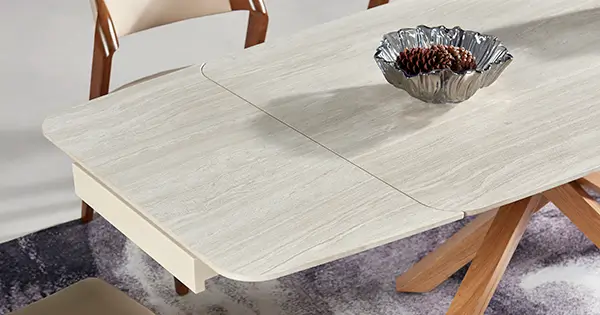
Ceramic Tabletops for Extendable Dining Tables
Extendable dining tables require more than simple tabletop cutting. Structural alignment, joint precision, and dimensional stability are essential to ensure smooth opening performance and long-term durability.
At Modura, we manufacture ceramic tabletops for extendable dining table programs using a precision-engineered multi-piece system designed for repeatable OEM production.
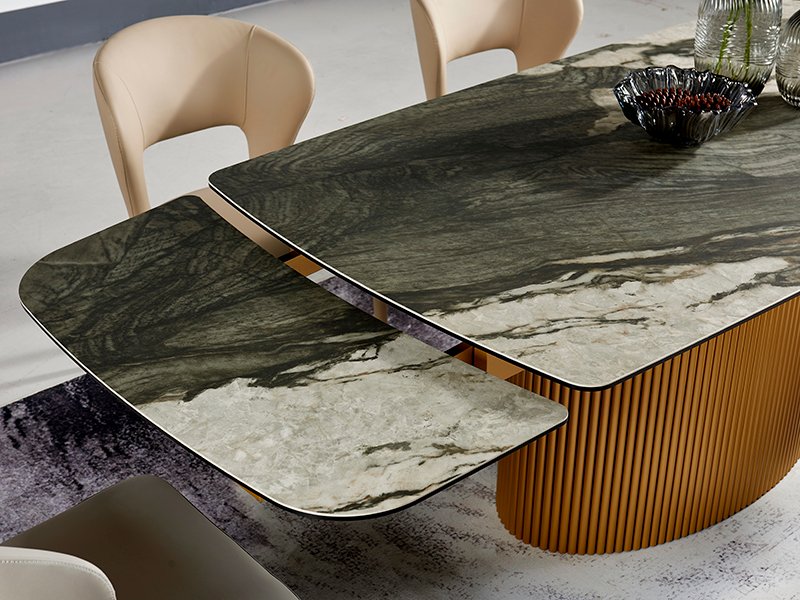
End sections of the extendable ceramic dining table tops
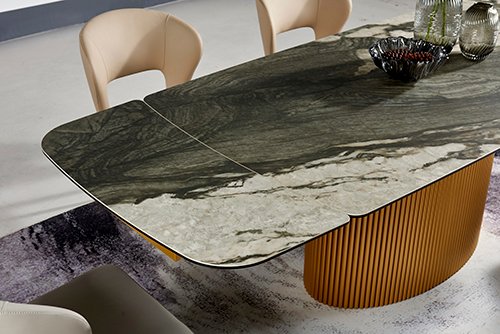
Our extendable ceramic tabletops are typically developed as a three-piece system consisting of a center extension panel and two end sections. Each component is manufactured with strict dimensional control to maintain balanced alignment during opening and closing.
Precise joint positioning helps reduce visible gaps and uneven transitions between tabletop sections. This ensures a cleaner appearance and more stable user experience in both residential and hospitality applications.
Production is controlled within a strict tolerance range to support seamless integration with extension hardware, sliding mechanisms, and frame systems.
Proper dimensional matching between ceramic sections, reinforcement layers, and table mechanisms helps ensure smooth extension movement without friction, misalignment, or structural instability over time.
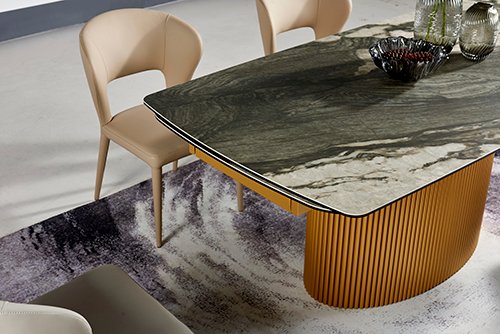
SURFACE ESTHETICS
Popular Dining Tabletop Surface Directions
A carefully curated material range developed to support residential series and repeatable contract hospitality layouts.
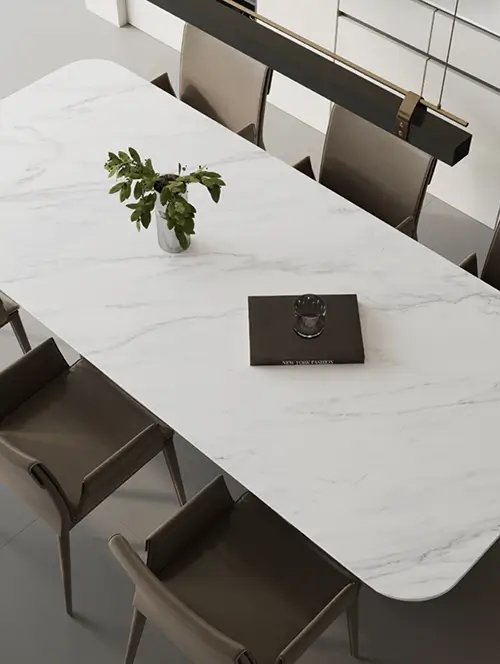
Elevate luxury residential dining with a highly durable, stain-resistant surface featuring realistic marble veining.
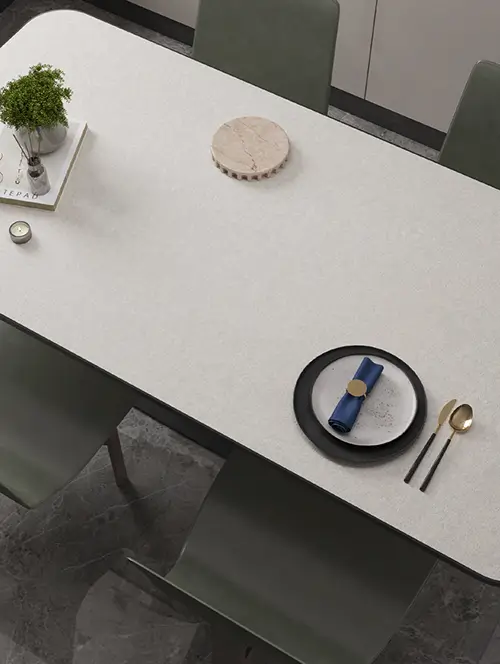
Enhance Scandinavian and minimalist collections with a low-reflection, smudge-resistant matte finish that provides soft visual comfort.
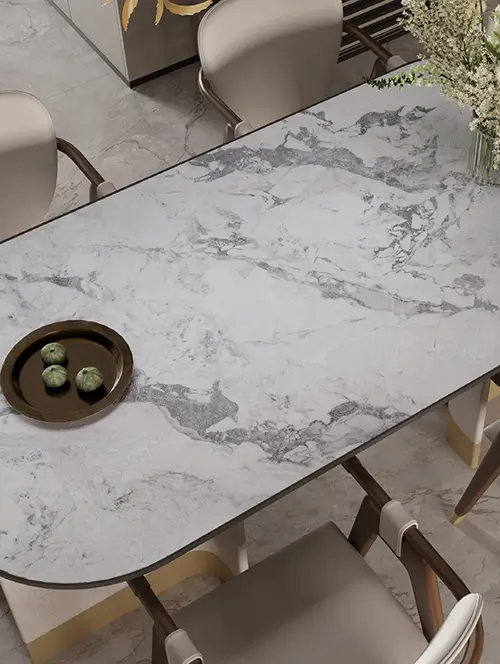
Bring organic warmth and softness to cozy contemporary dining with travertine -inspired stone textures.
Engineered for Dining Table Base Compatibility
Designed to integrate seamlessly with diverse dining table base systems while maintaining structural stability, dimensional accuracy, and long-term durability.
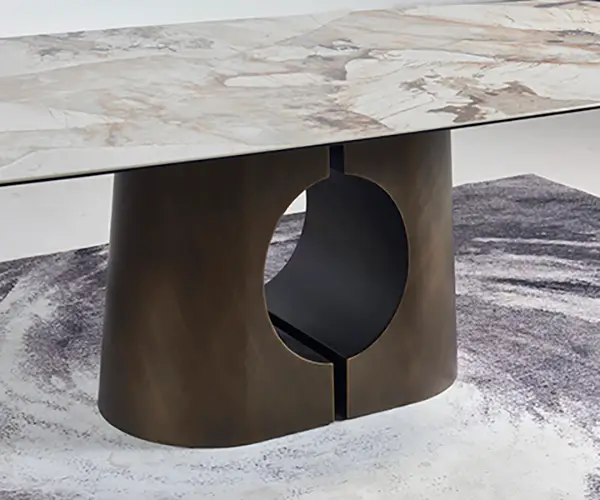
Pre-drilled fixing positions and precise dimensional control to ensure secure alignment with welded steel and aluminum structures.
44109.webp)
Stable support layouts engineered for solid wood and engineered timber frames, ensuring balanced load distribution and reliable tabletop support.
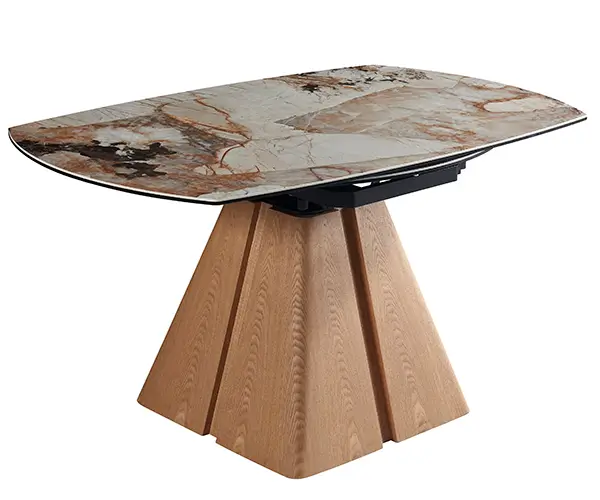
Beyond traditional wood and metal structures, ceramic dining tabletops can also integrate with fiberglass, mixed-material, and composite frame systems. With proper structural engineering, these solutions provide stable support for large-format dining tabletops while enabling more distinctive furniture aesthetics.
oem
Dining Table Program Development
From concept drawings to production and export packaging, we support seamless dining tabletop development for furniture brands, wholesalers, and OEM dining programs.
We review drawings, tabletop dimensions, frame compatibility, and mounting requirements to ensure precise integration with your furniture system before production.
Support for custom shapes, edge profiles, structure options, and extendable tabletop layouts to validate fit, finish, and functionality before volume production.
Consistent batch matching, controlled dimensional tolerances, and reliable lead-time management for recurring furniture collections and hospitality programs.
Frequently Asked Questions
What thickness is best for ceramic dining tables?
The ideal thickness depends on your table design, span, and visual direction.
For premium monolithic dining collections, 12mm or thicker full-body ceramic is often preferred to achieve a substantial stone appearance and support advanced edge detailing.
For modern slim-profile dining programs, laminated structures such as 3mm ceramic combined with 8 mm thick tempered glass are commonly used to improve structural stability.
Our engineering team can recommend the most suitable construction based on your tabletop size, frame system, and target market requirements.
Can ceramic dining table tops support long spans?
For extended lengths or thinner profiles, reinforced laminated constructions are commonly used to reduce the risk of bowing and improve structural performance.
The optimal solution depends on the tabletop dimensions, support points, and intended usage conditions.
What dining frame materials work best?
Ceramic dining tabletops are compatible with a wide range of base systems, including metal frames, solid wood structures, fiberglass, and mixed-material furniture bases.
The key factor is structural compatibility. Proper fixing methods, support distribution, and dimensional alignment are important to ensure stability and long-term performance.
For OEM projects, we can review your frame drawings to evaluate tabletop compatibility before production begins.
Are extendable ceramic tables difficult to manufacture?
Extendable ceramic dining tables require higher precision than standard fixed tabletops.
Because the tabletop consists of multiple moving sections, dimensional accuracy, joint alignment, and compatibility with extension hardware are critical to ensure smooth opening performance and consistent visual alignment.
With proper engineering and controlled manufacturing tolerances, extendable ceramic dining table tops can be produced reliably for scalable OEM furniture programs.
Develop Your Ceramic Dining Table Program
Built for Furniture Manufacturing Programs
|
OEM Development · Consistent Production · Export Ready